
Rock is everywhere in nature–whether it be a whole mountain, a little bit of rugged terrain, or a cliffside beach. And there’s more than one way to build a rock, so here are some ideas to get you started!

Studs Up
Let’s jump right in with the simplest LEGO rockwork technique–straight forward stacking slopes. In this example I used a pretty small amount of slopes to create an all-LEGO backdrop for Moses

In the next example, I started with a base of wedge plates.

Here I tried something a little more unusual, using an A plate for the base of a micro mountain.

This next example uses sand green as moss to top the rocks off.

You can also use two (or more) colors of slopes, to mimic the variety of layers usually seen in cliffs.

I like to go for a darker color on the bottom and lighter up top. This is also a nice way to get more mileage out of your collection than you would if you stuck with only one color!

As you can see, the important thing with this kind of rockwork is to avoid repetitive patterns. It’s a parts intensive technique that leaves you with jagged, texture covered cliffs.

Speaking of different colors, here’s an example of this style of studs up rockwork (with one or two slopes turned sideways, but not many) in tan and dark orange.

In the case of this next MOC, I knew my slope collection was just not going to cut it–so I used mainly bricks and mimicked the look of the large LEGO rock pieces. I don’t recommend these kind of flat rock walls for small builds, but if you’re doing a large cliff, it looks really nice at a big scale.

As you can see, this technique uses a lot of cheese slopes and a few inverted slopes, but not many other kinds.

Sideways Building
If you’re ready to take your rockwork to another level, try some SNOT (studs-not-on-top) rockwork.

These kinds of rocks get complicated fast, with slopes going in many different directions. It’s a great technique for creating unusual but still organic looking shapes.

A lot of times real rock formations have horizontal lines rather than vertical ones. Building sideways really helps achieve that look.

These chunks of sideways rock are time consuming, but very satisfying once they’re done!

A variation on the studs not on top theme can be used for cave roofs. This is definitely not my best rockwork, but it’s still a fun MOC because of the layout and mirror.

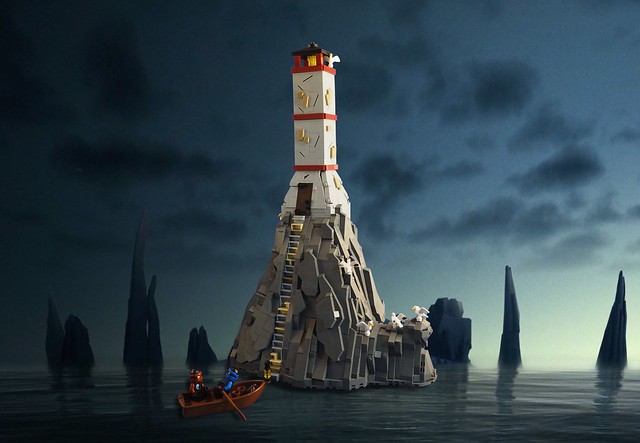
Moving on to some sideways rock I designed more recently, the base of this lighthouse is one chunk of slopes!

Not only are almost all the slopes going sideways, but some are even angled off grid using a central technic beam that you can see in this work in progress picture:

Your MOC doesn’t have to be all about rock for a little bit of rockwork to elevate it (see what I did there?). I ran a small layer of rock around this fun ice castle!

This is completely sideways, with some parts going straight out and others lying down horizontally.

If you’re looking to build a flat rock surface with only a few irregularities, sideways bricks look more realistic than tiles. And a sideways wall of grey is easy to build craters into.

This next MOC uses a wall of dark grey along with a few small sideways chunks in order to blend 3 and 2D.

As with the studs up rockwork, it’s also possible to leave the slopes out of your sideways rocks. This style of rockwork is great for large cliffs, since it has those horizontal lines.

These rocks use some slopes, but mostly bricks.

In the back, there are technic axles running through the layers and keeping them in place.

Angled Rockwork
In order to achieve a greater variety of angles and make your rockwork look less LEGO-like, you can angle your slopes at their base. For this large MOC, my brother and I used technic beams to angle large chucks of rock.

These are simple, one-directional angles that create a more pronounced and cliff-like slope. A big bonus for this style is that it allows you to use a lot of bricks (as opposed to slopes), without ending up with straight rock faces.

You can see that there are some gaps, but these are unimportant on such a large MOC.

This next massive chuck of rock blends angled techniques with sideways building for some unique formations. Many of these rock chunks are completely off grid.
The connections I used to achieve this involve clips and mixel joints (mixel joints are great for rotation in multiple directions).

When the math doesn’t line up, you can add bars and droid arms to the back end to achieve virtually any length. This technique is not very stable though!

This next smaller piece of rock also uses clips and bars for the angles.

One bonus (and drawback!) to using angled rock techniques is that the rock reaches the top at an angle, which lets you lay down plants in a naturally sloping way. Notice how some of the green leaves are at an angle below. The drawback is that it’s hard to fill in the gaps between the angled rockwork and the landscape on top!

This next MOC full of rockwork is a variation on the same theme, with quite a few different angles going on and some pieces being turned in more than one direction at once.

The back end is a mess for sure!

As you can see, these sections are not very stably connected–only one clip and bar!

Anything Goes
Each of the rockwork techniques we’ve looked at so far kind of builds on the previous one. Most of them make heavy use of LEGO slopes. But there are lots of other types of pieces that might be useful. The key to using random grey parts in your rockwork is fitting them in smoothly–which I admit I’m not that good at.
In this last example I used a variety of boat hulls, wedge plates, and tiles for my front rock. It’s a bit gappy though.

The back rockwork makes use of similar pieces. Here I did a better job avoiding gaps, and the gaps that are there don’t matter, since the final shot leaves them blurred.

Curves can also be very handy for certain types of rocks, especially cartoonish style rocks. I don’t have many large curved pieces, but here’s a great example.
Hopefully these rockwork examples have gotten you inspired! Let me know if you have any questions about them or other styles to share in the comment section below!
You might find these other technique roundups useful too:
 Geneva D
Great article! Thanks!
Glad you found it helpful! 🙂